
Some vineyards are measured in thousands of hectares. And then there is Condrieu, which is counted almost plot by plot. Roughly 220 hectares on the right bank of the Rhône, a single permitted grape variety, entirely manual work. Today it is one of the most sought-after white wines in the world. Sixty years ago almost nothing of it was left. Five minutes, and you will know the essentials.
Where are we?
Condrieu lies some 40 kilometres south of Lyon, on the eastern edge of the Massif Central. The vineyard drops steeply towards the right bank of the river. It sits wedged between Côte-Rôtie to the north and Saint-Joseph to the south. A little upstream, on the left bank and north of Vienne, stands the hillside of Seyssuel.
The appellation was created on 27 April 1940 across three communes only, Condrieu, Vérin and Saint-Michel-sur-Rhône. It expanded southwards in 1967 to Chavanay, Malleval, Saint-Pierre-de-Bœuf and Limony. Seven communes in total, spread over three départements. One rule has never changed, only still white wine is made here, from Viognier.
The wine that almost vanished
The story begins with the Romans. The Allobroges then occupied the right bank of the river facing Vienne. On gaining Roman citizenship they also gained the right to plant vines. Their wine was resinated, it was known as Allobrogica, and it was highly fashionable in the 2nd century. A dozen kilometres away, the archaeological site of Saint-Romain-en-Gal has yielded a mosaic from the early 3rd century showing a harvest and grape-treading scene.
The reputation then crossed the centuries without faltering. In the 17th century, at the gates of Paris, the wines of Condrieu were among those taxed at the highest rate, the one reserved for the greatest. Boileau asked for a delivery in a letter of 1710. Lamartine mentioned it in his correspondence. In the 18th century, the chapter of Lyon offered it to its distinguished guests.
Then everything collapsed. Phylloxera devastated the hillside at the end of the 19th century. A traveller passing through in 1893 described vineyards that were all but destroyed. The First World War emptied the countryside. The industrialisation of the Rhône valley then absorbed the labour force that had worked the slopes. The vineyard won a first mark of recognition in 1937 under the Côtes du Rhône appellation, then its own AOC in 1940. Neither was enough to halt the decline.
Here is the figure that makes your head spin. By the mid-1960s only 8 hectares of Viognier remained. Not just in the appellation. In the entire world. In 1975, a student gave his report the title « Is Viognier doomed? ».
One man held firm. Georges Vernay took over the family estate in 1953 with a single hectare on the Coteau de Vernon. His neighbours were pulling out vines to plant apricot trees. He replanted instead, and gradually persuaded those neighbours to do the same. He chaired the growers' association for some 30 years. Robert Parker would nickname him Mister Viognier. The region prefers to call him the Pope of Condrieu. Without him the variety would very likely have disappeared from its birthplace.
The revival came in the 1980s. The hillsides were replanted and the terraces rebuilt. In 1986, in the interest of quality, the growers revised the appellation area with the INAO and excluded every vineyard sitting above 300 metres of altitude. The delimited plot area was approved in 1989. The vineyard reached 150 hectares in 2009. It covers roughly 220 today.
A question of slope
Everything here is dictated by geography. The soils are born from the weathering of ancient metamorphic rocks of the gneiss family. They are sandy-clay, poor and friable. A few lenses of loess laid down in the glacial era complete the picture. The subsoil is fissured, which allows Viognier to reach deep for the water and minerals it needs. This variety favours acidic soils and is entirely at home here.
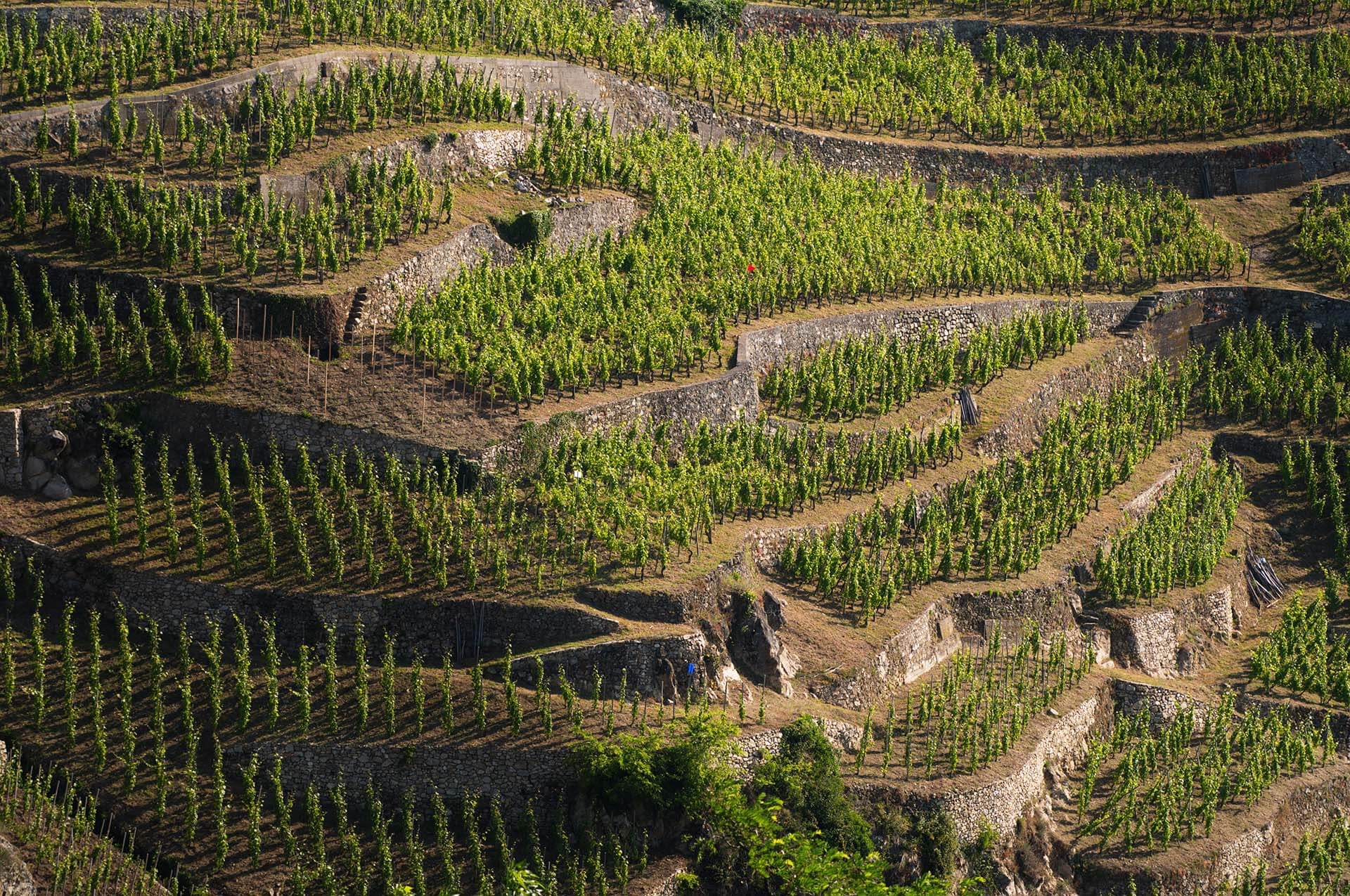
The slope is so steep and the soils so unstable that building was unavoidable. Since antiquity growers have carved out narrow terraces known as chaillées, whose soil is held back by dry-stone walls called cheys. Vines are trained on échalas, a simple wooden stake at least 1.5 metres tall. None of this can be mechanised. That is what explains both the rarity of these wines and their price.
The appellation rules impose a minimum density of 6,500 vines per hectare and forbid any vine from occupying more than 1.5 square metres. Rows may not exceed 2 metres apart. In practice many plots run between 8,000 and 10,000 vines per hectare. Yields are capped at 41 hectolitres per hectare and harvesting must be done by hand. The minimum natural alcohol level is set at 11.5 per cent.
That leaves the wind, and a common misconception to correct. The prevailing wind here is not a warm breath from the south. It is the bise, a cold dry northerly. It dries the foliage and limits fungal disease, which is invaluable. But it forces growers to choose sheltered sites. Hence the general south and south-east orientation that characterises the whole vineyard.
A final word on the grape itself. Legend has it that the Roman emperor Probus brought it from Dalmatia in the 3rd century. Research into the grapevine genome tells a simpler story. Viognier descends from ancient wild varieties of the northern banks of the Rhône. It was born here. It appears as early as 1781 under the name vionnier, alongside serine, in a natural history of the Dauphiné devoted to the wines of Vienne.
What does it taste like?
You first need to grasp how much this variety complicates a grower's life. It buds early and is therefore exposed to spring frosts. It fears drought and millerandage. Its production is irregular and its bunches are small and compact. It is planted here at the northern limit of its cultivation, which gives it its potential but leaves little margin for error. Its trickiest trait is its ability to reach very high natural sugar levels. Picked too early it says nothing. Picked too late it turns heavy. That is where the whole difficulty lies.
The classic profile is unmistakable. The colour is gold with intense golden highlights. The nose develops strongly marked ripe fruit aromas, peach and above all apricot, sometimes violet and white flowers. The palate is powerful and rich, almost unctuous, yet never heavy, because a good vivacity underpins it and carries the finish.
But it would be wrong to reduce Condrieu to that opulence alone. The appellation also produces wines that are far finer and far more linear. And that difference is largely settled in the cellar, through an adjustment few wine lovers know about.
It all comes down to fermentation temperature. The lower you go towards 14 degrees, the more esters the yeast produces and the more fermentation aromas dominate, the ones described as amylic, recalling banana or boiled sweets. The wine becomes exuberant and immediately appealing. The higher you go towards 20 or 22 degrees, the less those aromas form. Some growers deliberately let fermentation climb above 22 degrees for a few days. The result is a wine that speaks less of its yeast and more of its fruit and its terroir. Less demonstrative on the nose, more vinous on the palate, with a texture and a length that call for food. This is the gastronomic Condrieu.
One last word on ageing. It is often said that these wines should be drunk within the year. That holds true for many cuvées, prone to oxidation and delicious young. But the great bottles hold for up to 20 years, gaining musk, honey, gingerbread and tobacco along the way.
Dry today, sweet in the past
Here is a quirk that is often forgotten. In the middle of the 19th century, Condrieu was a sweet wine, drunk six months after vinification. The dry style only took hold in the 20th century.
The tradition has not entirely vanished, however. The appellation rules still permit a tiny production of moelleux and doux, made in good years from overripe grapes picked by successive passes through the vines. If you come across a bottle, take it.
A few names worth knowing
Domaine Georges Vernay remains the historic benchmark. His daughter Christine now runs it under certified organic farming and produces cuvées that have become legendary, among them Coteau de Vernon and Les Chaillées de l'Enfer. Around it, the appellation counts some very fine houses, starting with Yves Cuilleron in Chavanay. A good share of the estates are in fact spread across the southern communes brought in during 1967.
One curiosity is worth flagging. Enclosed within the Condrieu area, the Château-Grillet appellation stands apart on just a handful of hectares. It was already named in 1781 alongside Condrieu as one of the two great whites of the district.
How to enjoy it
Never serve a Condrieu ice cold, you would lose all its perfume. Between 11 and 13 degrees it gives its full measure.
At the table, one reflex is enough to keep you out of trouble. This wine has richness and moderate acidity. It therefore needs dishes with substance, and above all no acidic or briny dishes that would make it seem flabby. Forget oysters and sharp vinaigrettes, save it for melting textures.
For the richest cuvées, head towards richness and sweetness. Mi-cuit foie gras remains the reference pairing, the power of the wine answering that of the dish. Roast chicken in a cream sauce works for the same reason. Grilled lobster or sweetbreads hold their own perfectly well.
For the more linear cuvées, the gastronomic ones, you can aim subtler. Lyonnais quenelles make a magnificent match, the richness of the sauce finding in the wine both something to accompany it and enough backbone not to drown in it. Asparagus is the other great test, since few wines survive it. Viognier is one of the rare ones to pass, its gentle bitterness meeting that of the vegetable. River fish or frogs' legs also work very well.
For cheese, the obvious answer is local. Rigotte de Condrieu, a small goat's cheese with PDO status born on the slopes of the Pilat, sets its lactic freshness against the richness of the wine. And to finish, an apricot dessert echoes the grape itself.
In 5 minutes you have the essentials. But it takes rather longer to understand how a variety reduced to 8 hectares worldwide became one of the most coveted whites on the planet. The answer lies in a handful of impossible hillsides, and in the stubbornness of those who refused to abandon them.