
Food and wine pairing is often presented as an art reserved for sommeliers, full of secrets and forbidden combinations. That's simply not true. Behind a good pairing lies a handful of simple, almost mechanical principles that anyone can understand and apply. Once you have them, you can reason for yourself — even faced with a dish as thoroughly Lyonnais as a pâté-croûte.
The principles of food and wine pairing
A successful pairing is not a matter of personal taste — it is first and foremost a question of balance between what the dish does and what the wine does. Here are the key levers, from most to least important.
Weight, first. The first instinct is to match the intensity of the dish with that of the wine. A light dish will be overwhelmed by a powerful wine, and a rich dish will make a light wine seem thin and washed out. Before even thinking about aromas, ask whether the dish is delicate or substantial, then choose a wine of comparable weight.
Acidity, your best ally. A wine's acidity cuts through fat and richness, like a squeeze of lemon on fish, and refreshes the palate between bites. Faced with a rich, salty or creamy dish, an acidic wine will almost always outperform a flat one. This is the most useful lever of all.
Tannins, best handled with fat. Tannins slightly dry out the mouth and bind to proteins and fats — on fatty meat they soften. However, they clash with salt, chilli and iodine-rich fish, turning bitter or metallic. A highly tannic wine calls for a dish substantial enough to absorb them.
Sugar, which must dominate. A sweet wine must always be at least as sweet as the dish, or it will taste lean and sour. Sugar in a wine does wonders alongside saltiness and spice — this is the entire logic behind Sauternes with roquefort, or a moelleux with spiced cuisine.
For aromas, a pairing can play two strategies. Similarity echoes the dish — a buttery, mellow dish with a round, vanilla-inflected white. Contrast opposes two characters that balance each other — fat and acidity, salt and sweetness. Both work, provided you have first respected the balance of weights.
One last point that is often overlooked: the dish transforms the wine just as much as the wine accompanies the dish. The salt and acidity of a dish make the wine taste rounder and fruitier. Conversely, sugar, bitterness and umami harden the wine, making it seem drier and more bitter. A salty, mildly acidic dish flatters almost any wine — a sweet or intensely umami dish does the opposite.
Why Lyonnais cuisine complicates the pairing
Lyon has a reputation as a gastronomic capital, but its traditional cuisine is above all generous and hearty. It springs from two heritages: peasant cooking of pork and offal, and the Mères Lyonnaises who elevated this domestic cooking to a recognised table. The result is a cuisine of pork and offal — charcuterie, saucisson, andouillette, quenelle in sauce, gratons — often bound with butter or cream.
This is where the trap lies. Faced with such a rich dish, instinct pushes you to reach for a big, powerful, tannic red. But that is usually a mistake. The fat and salt of Lyonnais cuisine do not call for power — they call for freshness. An acidic, thirst-quenching wine cleans the palate, while a heavy tannic wine adds to the dish's richness and clashes with its salt.
It is no accident that Lyonnais tradition embraced Beaujolais and Rhône wines, served in the famous 46-centilitre pot. Beaujolais gamay is the archetype of the wine suited here: fruity, very fresh, low in tannin. It cuts through the fat without ever weighing things down. The lesson applies to almost every Lyonnais dish: seek freshness and acidity first, be wary of tannins.
Under the microscope: the pâté-croûte
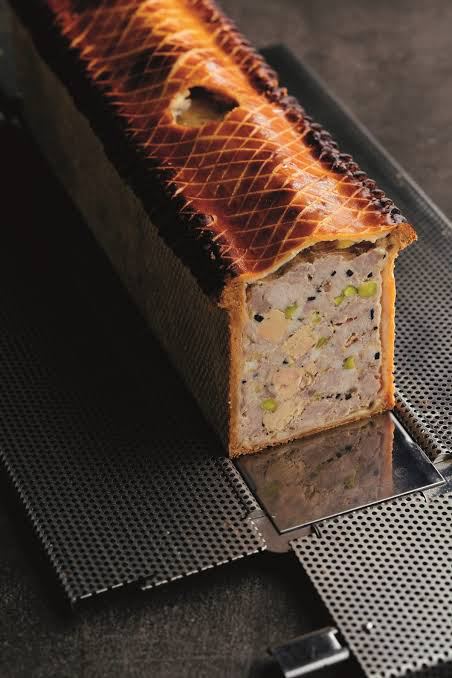
The pâté-croûte is a charcuterie pastry: a meat filling — most often pork and veal, sometimes enriched with poultry, game or foie gras — seasoned with spices and pistachios, enclosed in a buttery pastry crust with a thin layer of jelly. It is served as a starter, sliced. The city is so attached to it that since 2009 it has hosted a dedicated world championship.
Let us run it through our principles. The pâté-croûte stacks several challenges: a fatty, savoury filling (umami and fat), the salt of the charcuterie, a buttery crust, and often a touch of spice. Served cold, the fat stands out all the more. What does this picture call for? Acidity to cut through the fat, moderate tannins to avoid clashing with the salt and umami, and enough fruit to accompany the filling.
The pairing I recommend: a Beaujolais cru. A Fleurie or a Morgon, for instance. Gamay ticks every box: a frank acidity that cleans the fat with each bite, juicy red fruit that marries the filling, and discreet tannins that never quarrel with the salt of the charcuterie. This is the safest, most Lyonnais pairing — and the one that best illustrates our principles at work.
Two alternatives if you want to explore other approaches. A vivid, aromatic white — in the spirit of a Jura wine, a Savoie, or an Alsace Riesling — plays on contrast: the white's acidity and tension cut through the fat while its aromas lift the filling. This is often superb on poultry versions. A traditional-method sparkling wine — Champagne or Crémant — produces an immediate effect: the bubbles and acidity literally scrub the fat.
Special case: pâté-croûte with foie gras. Foie gras adds a richness and meltingness that change the equation. A touch of sweetness in the wine works wonders: a Jurançon moelleux or a well-aged Champagne will envelop that richness rather than fight it.
What to avoid. A young, highly tannic red — a Bordeaux built for ageing, a Cahors, a muscular Syrah. The salt of the charcuterie hardens the tannins, turning them bitter, while the wine's power crushes the finesse of the filling. This is the perfect example of a pairing that seems logical on paper — a rich dish calls for a powerful wine — but betrays the principles.
In summary
Remember the approach, not the list. First match the weights, use acidity to cut through fat, moderate tannins in the face of salt, and keep in mind that the dish transforms the wine just as much as the reverse. Applied to Lyonnais cuisine, these instincts almost always lead toward freshness — Beaujolais first. And on a pâté-croûte, they point directly to a fine Beaujolais cru as the reference pairing.
It is this way of reasoning — rather than pairings learnt by rote — that we love to share during our tastings and workshops in Lyon. Once you hold the logic, every dish becomes a small problem you take pleasure in solving, glass in hand.