
We use both words as though they mean the same thing. Yet they describe gestures whose aims are diametrically opposed. Aerating is about giving a wine air. Decanting is about trying to give it as little as possible. The vessel is the same — a glass container — and that is precisely what perpetuates the confusion.
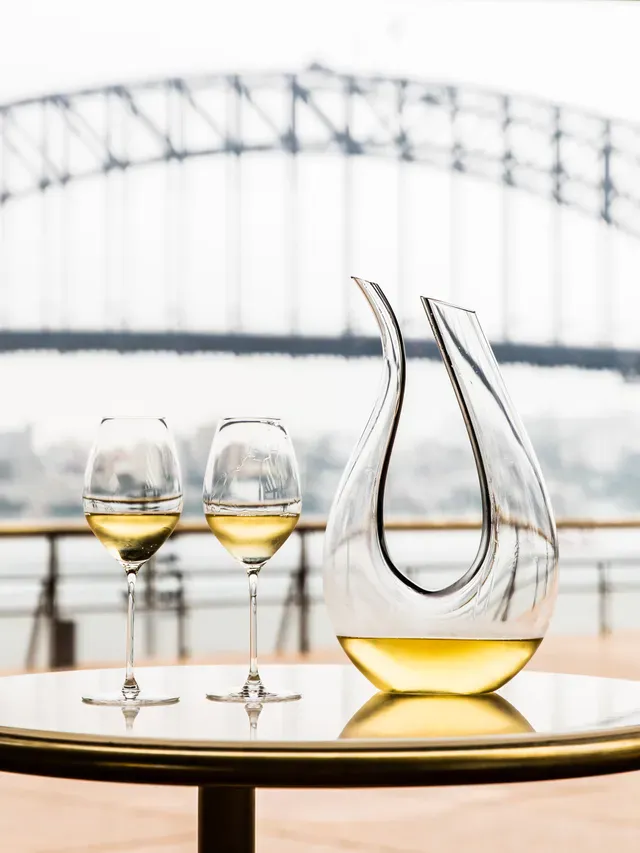
Two gestures, two intentions
A young wine leaves its bottle after months sheltered from air. It often arrives closed, aromas stingy, tannins slightly rough. Putting it in a carafe at once offers it a considerable exchange surface — tannins round out, any mustiness dissipates, and the bouquet finally opens up. That is aerating.
Decanting obeys an entirely different logic. In an old bottle, tannins and colour pigments have aggregated into a sediment at the bottom — harmless, but clouding the colour and hardening the texture. You pour the wine into a decanter to separate it from this sediment, and the oxygen you unavoidably expose it to in the process is a drawback to minimise, never a benefit.
Hence the fundamental rule, the one to keep in mind above all others: you aerate a young wine to open it, you decant an old wine to clean it.
Aerating: rapid oxygenation
The right carafe for this purpose has a wide base and a flared neck, since everything hangs on the exposed surface area. Pour the wine in without particular care, and leave it to rest without recorking.
How long? The answer depends on the wine far more than on any general rule. Thirty minutes transforms some cuvées, while a dense tannic red may need two hours. The received idea that whites have nothing to gain from it is wrong — an age-worthy white that is slightly reduced on opening is often transformed by it.
One observation that holds for every case: swirling the wine in the glass, a gesture we think of as decorative, produces surprisingly effective aeration. If you forgot to aerate, it's not fully recovered — but it's not lost either.
Opening in advance: slow aeration
You often read that uncorking a bottle a few hours before dinner is pointless, since the exchange surface is limited to the neck's diameter. That argument holds for one or two hours — and becomes false as soon as you extend the time. The surface ratio between a bottle neck and a carafe is roughly one to thirty. One hour of aerating therefore equates, very approximately, to twenty-four to forty-eight hours of an open bottle.
Emmanuel Reynaud at Château Rayas recommends opening his wines twenty-four hours before serving, pushing this to two or three days for young vintages of Rayas. The appeal of this protocol is not just the result — it is the margin for error. A carafe overdone can push a wine past its equilibrium in an hour, with no way back. Slow opening leaves time to observe and adjust.
Decanting: a more delicate operation than it appears
Decanting is never compulsory — it is decided case by case, and it carries a risk it would be dishonest to conceal. A wine that has reached maturity has shed structure over the years, and whatever bouquet remains is fragile. Air can wake it up magnificently or cause it to collapse within minutes. Consider decanting as a race against time that begins the moment the cork leaves the neck.
Preparation matters as much as the gesture itself. Stand the bottle upright the night before so the sediment falls. Handle it without shaking, uncork at the last moment, then pour slowly in one continuous movement into a narrow, lightly flared decanter. The candle that sommeliers slide under the neck is not a flourish — it illuminates the neck by transparency and allows you to stop pouring the moment the sediment arrives. Once done, serve without delay.
How to decide in practice
The most reliable method costs nothing. Open, pour yourself a small taste, wait twenty minutes, and taste the same glass again. If the wine has opened up, gained in fruit and roundness, it needs air and you know what to do. If it is already starting to fade, serve it as-is and leave it alone.
This test also resolves the awkward case of bottles around fifteen years old — too mature to need aeration and too young to justify decanting. The glass will decide better than any rule.
One point worth adding, as it can save a bottle. A reduced wine corrects well through aeration. An oxidised wine, on the other hand, cannot be repaired, and air will only accelerate its decline.
To conclude
Getting the vocabulary straight means already choosing the right gesture. Aerating is about oxygenation and addresses young wines, with a wide carafe and a little time. Opening the night before produces the same effect far more gently. Decanting is about clarification and addresses old wines, with a narrow decanter, a bottle stood upright the day before, and immediate service.
This is the kind of demonstration we love to do during our tastings in Lyon, because it takes twenty minutes and two glasses. The same wine, aerated in one, poured straight in the other, and the discussion is settled.