
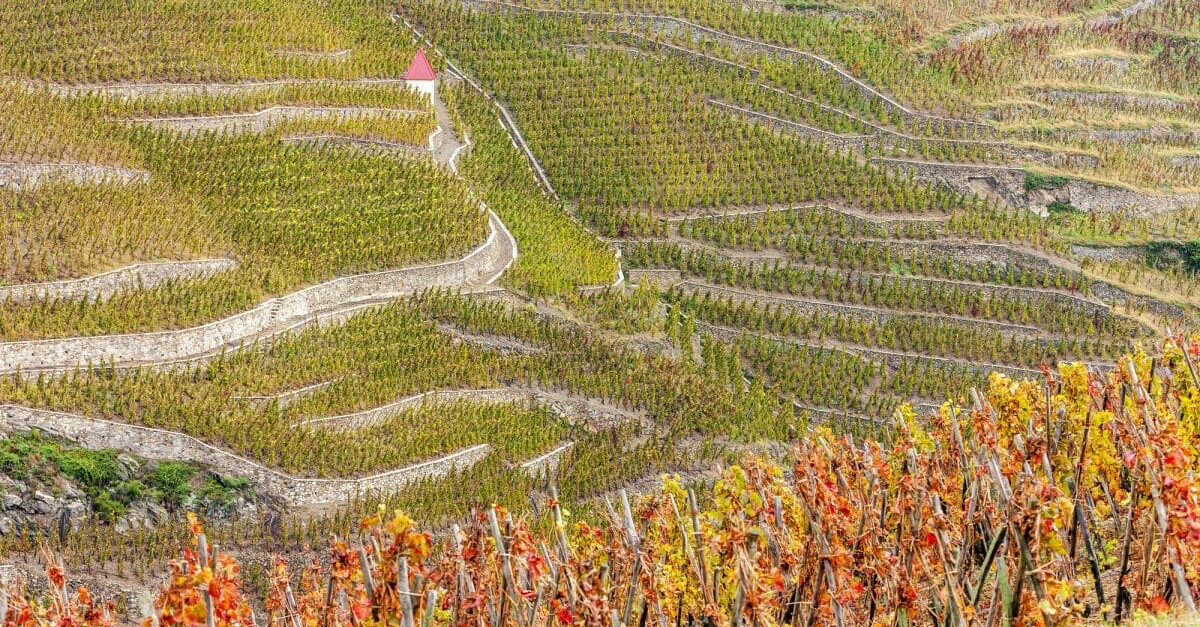
In France there are vineyards one admires from afar, and then there is Côte-Rôtie, which you look up at with your head raised. Clinging to vertiginous slopes above the Rhône, it is one of the oldest and most spectacular expressions of Syrah in the world. Its name says it all: the 'roasted slope' — the hillside that the sun bakes from morning to night.
Where are we?
Côte-Rôtie opens the northern Rhône valley, about thirty kilometres south of Lyon, right across from the Roman city of Vienne. It is the northernmost appellation among the great crus of the northern Rhône, stretching around the villages of Ampuis, Tupin-et-Semons and Saint-Cyr-sur-le-Rhône.
The location is anything but ordinary: the Romans were already planting vines here two thousand years ago. The appellation was officially recognised in 1940, but the vineyard nearly disappeared in the mid-twentieth century. Working these slopes by hand, with no machinery possible, was too costly for wines that were then largely unknown. It was a handful of growers, Marcel Guigal leading the way, who relaunched it from the 1960s and 70s, lifting Côte-Rôtie to the rank of world reference.
A story of slope
Everything here is dictated by geography. The hillsides plunge towards the Rhône at gradients that reach 60 degrees in places. No tractor can work them. Growers cultivate narrow terraces supported by dry-stone walls (the chaillées) and often train the vine on a single stake, a simple wooden post — a technique that has almost disappeared elsewhere in France.
This full south to south-east exposure is the key to everything. This far north, Syrah would struggle to ripen on flat ground. On these exposed slopes, every berry receives maximum heat and light — hence the appellation's name. It is heroic viticulture, and it is also what gives these wines their intensity.
Côte Brune and Côte Blonde
The historic heart of the appellation divides into two sectors of very distinct character, and it is worth knowing the difference.
Côte Brune, to the north, rests on dark schist soils rich in iron oxide and clay. It produces powerful, structured wines, very tannic when young and built for ageing.
Côte Blonde, to the south, sits on paler soils of gneiss and decomposed granite, with a sandy and micaceous touch. Its wines are finer, more fragrant, more tender — immediately elegant.
Local legend has it that a lord of Ampuis, Maugiron, divided his land between his two daughters — one dark-haired, one blonde. A lovely tale, and one that fits the reality of the soils perfectly.
The grapes: Syrah, and a hint of Viognier
Côte-Rôtie produces only red wine, and Syrah is its sole base. But here is its most famous singularity: the regulations allow up to 20% Viognier, a white grape, in the blend.
More surprising still, this Viognier is not added afterwards. It is co-fermented — vinified at the same time as the Syrah, white and red grapes mingled in the same vat. The result is subtle: the Viognier adds extra floral perfume, stabilises the colour through co-pigmentation, and rounds the texture. In practice, most estates stay well below the legal ceiling, around 5% or less, and some use none at all.
What does it look like in the glass?
A Côte-Rôtie is typically a deep-coloured wine, medium to full-bodied, with fresh acidity and fine but present tannins.
On the nose, it is a festival: violet first — the aromatic signature of northern Syrah — then black pepper, dark fruits (blackberry, blackcurrant), and that savoury, characteristic note of smoked bacon, black olive and grilled meat. When Viognier joins the party, it adds a touch of apricot and white flowers that brightens everything.
It is a wine that ages magnificently. Good-vintage bottles are often best after eight to ten years, and the finest can cross decades without faltering.
Tradition versus modernity
As so often in great vineyards, two schools coexist. Traditional growers favour whole-bunch harvesting (uncrushed clusters), long macerations and ageing in old large barrels or demi-muids, to preserve the purity of fruit and the character of the place.
The modern approach, popularised by Guigal with their famous single-vineyard cuvées ('La Mouline' from the Côte Blonde, 'La Landonne' from the Côte Brune, 'La Turque'), favours long ageing in new barriques, richer and more oaked. Both styles have their admirers and produce very great wines. Tasting both is the best way to form your own view.
Names to know
Beyond Guigal, the appellation abounds with remarkable estates: Jamet, René Rostaing, Clusel-Roch, Jean-Michel Gerin, Stéphane Ogier, Bernard Levet, and Georges Vernay. The Barge family, established in Ampuis for several generations, also upholds this tradition of demanding slope work and a straight, expressive Syrah, in the most authentic spirit of the appellation.
How to enjoy it
Serve a Côte-Rôtie at around 16–17°C, and do not hesitate to decant if it is young: it needs air to unfurl its aromas. At the table, it loves game, grilled red meats, lamb — but also, more mischievously, a dish seasoned with pepper, echoing its own profile.
In five minutes, you have the essentials. But Côte-Rôtie is one of those wines that you truly understand with a glass in hand, eyes turned towards those impossible slopes that generations of growers have refused to abandon. It is there — in the effort as much as in the glass — that its greatness lies.
Planning a team day? Discover our offsite rooted in this terroir, with local wine and seasonal food.
Discover the offsite