
Stand at Ampuis, in the heart of Côte-Rôtie, and look east, across the Rhône. The steep hillside you see on the left bank, just north of Vienne, is Seyssuel. The same schist as Côte-Rôtie, the same Syrah, the same full-south exposure. And yet most visitors driving down from Lyon pass right by without knowing it exists.
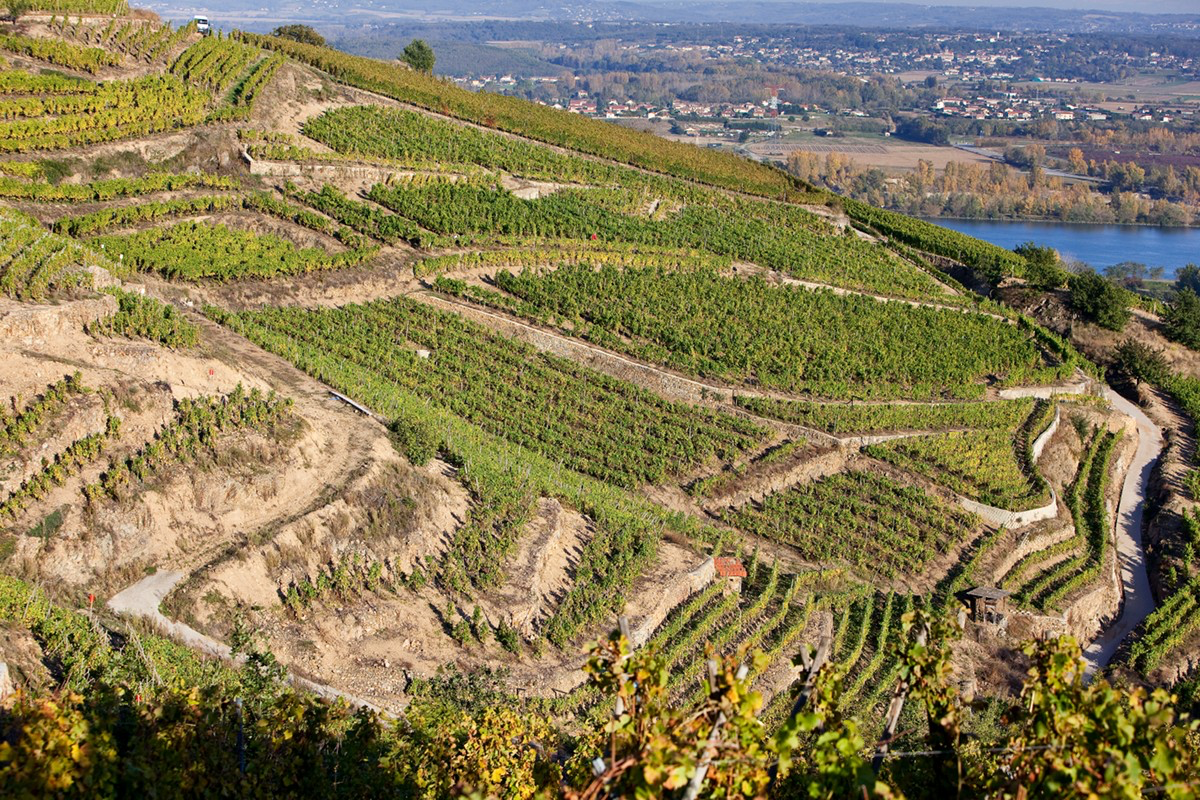
It is a vineyard that richly deserves a closer look. We will explore where it comes from, why its soil matters so much, and what all of that translates to once you have a glass in hand.
A history of the appellation
Seyssuel is anything but a recent invention, and that matters for understanding everything that follows. The Romans were already planting vines on this left bank of the Rhône nearly two thousand years ago, around the city they called Vienna. The wines were reputable enough to be mentioned by several ancient authors, among them Pliny the Elder, Plutarch and the poet Martial. For centuries, a share of Vienne's wealth came from its vineyards.
In the nineteenth century, the hillside still held around a hundred hectares, and its wines were sought as far as Lyon. Everything changed in 1883 with phylloxera, the American aphid that devastated the French vineyard. Unlike Côte-Rôtie and Condrieu on the opposite bank, Seyssuel was never replanted: the slopes were too hard to work, flat land was preferred, and the arrival of the motorway drove land prices up. The vineyard simply ceased to exist.
This is the detail that explains its current status. In the late 1930s, when the INAO drew the map of AOC appellations, there was simply nothing left to classify at Seyssuel. The result: the hillside still has no appellation of its own. However ambitious the wines, each bottle can only carry the IGP Collines Rhodaniennes designation or, more modestly, 'Vin de France'. A strange dissonance for wines that often stand shoulder-to-shoulder with their neighbours across the river in blind tastings.
1996: a three-grower wager
The renaissance came from three growers you will quickly encounter when exploring the northern Rhône: Yves Cuilleron, Pierre Gaillard and François Villard. All three were already recognised young producers in Côte-Rôtie, Condrieu and Saint-Joseph, and it was together that they decided to bet on this forgotten hillside.
One evening in 1996, they founded Les Vins de Vienne together, separately from their own estates. They cleared and replanted the steepest slopes — some inclined at up to 60% — and released their first red, the Sotanum, in 1998. The first white, the Taburnum, followed in 2000. The cuvée names are deliberately Latin, a tribute to the Roman wines of old. The wager paid off, and other growers gradually followed them up the hill.
The terroir
This is the part I enjoy most, because it is where everything is decided. I will take each parameter in turn, because it is only by stacking them that you understand why these wines have the character they do.
The soils. The hillside rests on schists, micaschists and quartz schists, complemented by gneiss and leucogneiss, with an almost vertically oriented micaschist bedrock. This geology is very close to that of Côte-Rôtie and Condrieu directly opposite. These rocks drain water quickly, warm up well, and force the vine to plunge its roots deep to find moisture. This is what gives the wines their mineral backbone and their natural concentration.
The river. The Rhône flows below and plays a genuine role. At this point the valley narrows sharply. The bottleneck accelerates the wind, which cools the vines at night. This nocturnal temperature drop is the signature of Seyssuel: it preserves acidity and freshness in the grape, keeping ripe fruit in balance.
Exposure. The best plots face due south to south-south-west, on steep slopes that catch the sun from early morning. This sharp incline amplifies the sunlight received. At such a northerly latitude, it is not a luxury — it is what allows the grapes to ripen fully.
Continentality. Seyssuel, inland and shielded from the Atlantic by the Massif Central, clearly bears the mark of a semi-continental climate: hot, dry summers, genuine winters, and wide swings between day and night temperatures. This thermal amplitude promotes aromatic complexity and preserves freshness in the wines.
The grapes. As throughout the northern Rhône, two varieties dominate: Syrah for the reds and Viognier for the whites, sometimes complemented with a little Roussanne. Familiar varieties, perhaps, but expressing something distinct when placed on this specific terroir.
The winemaking. The slopes rule out any mechanisation: harvesting is done entirely by hand, followed by rigorous sorting. The reds are most often destemmed, fermented in tank, then aged in barrel for anywhere from ten months to nearly two years depending on the estate. Many producers work organically, with an attention to detail that already brings Seyssuel close to the standards of a recognised AOC.
From terroir to glass
The schist, the south-facing slope, the night wind and the thermal swing do not stay on the fact sheet — they are tasted. The notes below describe the general profile of the hillside, not any specific vintage or cuvée.
The reds are Syrahs with a typically Rhône accent: a deep robe, a nose of dark fruit (blackberry, blackcurrant), pepper and violet, with that smoky, almost saline note that schist imparts. What strikes you is the freshness: thanks to the wind that cools the nights, the wines feel taut and energetic rather than heavy. The substance is concentrated but never ponderous, carried by fine tannins and a satisfying length.
The whites come from Viognier, the same grape as the Condrieu across the river. At Seyssuel, it tends to retain more energy and salinity, with the apricot and white blossom held in check by firmer acidity. If you find some southern whites a touch opulent or heady, this one may well surprise you with its precision.
My favourite: Domaine Eymin-Tichoux
If there is one to start with, it is this one. Sophie Eymin and Kevin Tichoux brought the vine back to the hillsides of Seyssuel, starting to clear the land in 2014 before planting their first Syrah vines in spring 2015.
The estate now covers around 4.5 hectares, farmed organically, with horse ploughing on the steepest plots, vines trained on individual stakes and fully manual harvesting. It is demanding, old-fashioned work, and it shows in the purity of the wines.
Their first cuvée, L'Arène, a Syrah red released in 2018, was immediately singled out by the Revue du vin de France, which praised its lush fruit, Côte-Rôtie spirit, rounded tannins and fine length. The Cap Syrah cuvée and their white Viognier show the same signature: freshness, precision and a quality-to-price ratio that is hard to beat at this level.
It is exactly this kind of estate that anchors the sunset tastings we organise in the Seyssuel vineyards, facing Côte-Rôtie. The idea is not to recite a fact sheet, but to taste these wines in the landscape that explains them. If you want to discover the northern Rhône beyond the famous names, this is honestly where I would start.