
It is probably the most underestimated object in tasting. We willingly spend twenty euros more on a bottle, then serve it in the first glass to hand — often thick and cut — and part of what we just paid for never reaches the nose. The glass is not an accessory, it is an instrument. And like every instrument, it follows a few simple principles you only need to understand once to never go back.
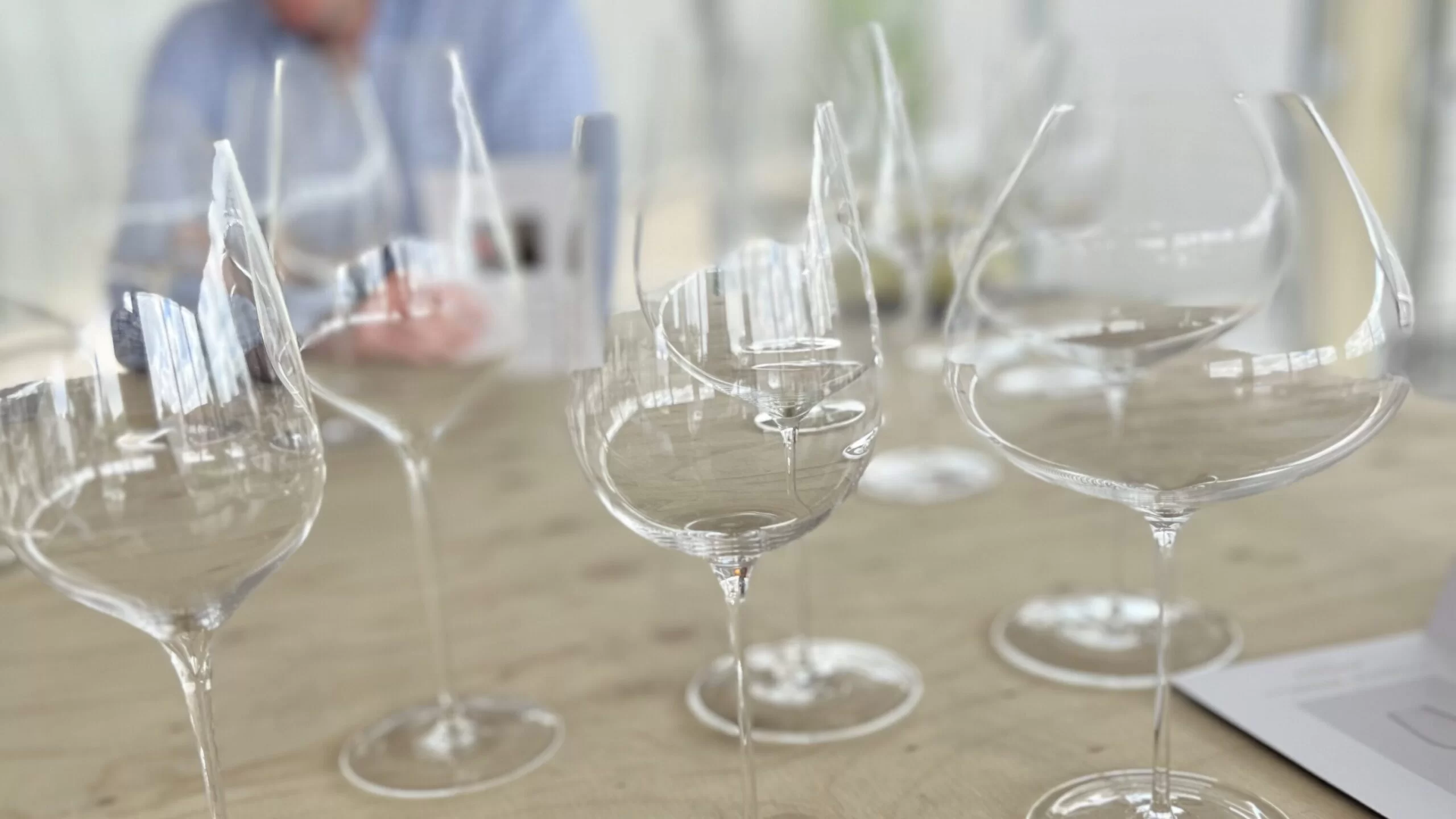
The anatomy of a glass
The bowl holds the wine and governs both aeration and aroma concentration. The chimney is the upper wall of the bowl — the more open it is, the more aromas escape sideways instead of rising toward the nose. The rim is where the lips rest: it should be thin, cut after moulding, to disappear on contact. The stem separates your hand from the wine to prevent your palm's warmth from heating it. The foot provides stability and allows you to swirl the glass on the table.
What the glass actually does
The first mechanism is aeration. A wine only releases its aromas by oxygenating, and the larger the surface exposed to air, the faster the volatile compounds are released. This is the entire role of a wide bowl — and also why a narrow glass filled to the brim gives almost nothing.
The second depends on the form, which either concentrates or disperses. The determining factor is not the absolute size of the glass but the ratio between its maximum diameter and that of its opening. A bowl that narrows clearly at the top gathers the released aromas and directs them toward the nose, while an opening as wide as the belly of the glass lets them escape.
The third mechanism, more subtle, concerns alcohol. Ethanol evaporates faster than water and its vapour masks delicate aromas. Japanese researchers managed to photograph these vapours, and their images show that the form genuinely alters their density and position at the opening. A well-designed glass pushes alcohol toward the rim and allows aromas to rise at the centre.
The most common mistakes
The most widespread by far is holding the glass by the bowl. Your hand warms the wine within minutes — enough to unbalance a white served chilled. The stem and foot exist for exactly this reason.
Next comes excessive generosity. The wine needs space above it for aromas to gather, and you cannot swirl a full glass. The tasting protocol calls for no more than one-third of the volume, and at the table, filling to the widest point of the bowl remains the best guide.
Then there is the poorly rinsed glass: probably the main cause of spoiled wine at home. A glass stored for a long time in a cupboard takes on a musty smell that immediately contaminates the wine, and a poorly washed glass retains a film of washing-up liquid that prevents aromas from being perceived correctly.
Do you need one glass per grape variety?
This is the question worth money, since it forms the central argument of the major glassware houses. What is established is that glass shape modifies perception. Chromatographic analyses have measured real differences in the air composition above wine across different glasses. What is far less established is the specificity per grape variety. A study published in the Journal of Wine Research had tasters smell different wines blind in several glasses: results showed individual preferences stronger than any reproducible grape-specific effect.
The reasonable conclusion fits in one sentence: invest in a good glass rather than a collection of glasses. The difference between a mediocre glass and a good glass is considerable — the difference between two good glasses of similar shape is marginal.
Which glass to buy
For tasting and learning, the INAO glass remains the reference instrument. Its tulip shape, modest bowl and narrowed opening were not designed to flatter the wine but to render it without amplifying its faults — which makes it the standard for competitions and juries. It costs a few euros each.
For the table, a generous red wine glass will do in the vast majority of cases: a wide bowl that narrows clearly toward the top, a thin rim and a long enough stem to hold the glass without ever touching the wine. This is the universal glass, and it suits whites perfectly too. If you want a second model, opt for a white wine glass — simply narrower.
For sparkling wines, one thing only: the flûte is a heresy. It was designed to display a ribbon of bubbles — that is, for the spectacle — and sacrifices everything else. Its narrow chimney lets almost no aromas express themselves. Serve your sparkling wines in a white wine glass, or in a universal glass for vinous, barrel-aged Champagnes, and you will get twice the pleasure.
To conclude
Glass shape has a real effect — through aeration, aroma concentration and alcohol vapour management. The promise of one glass per grape variety, however, owes more to commerce than to science. A good universal glass, held by the stem, filled to one-third and properly rinsed will give you more than any collection.
The best thing is still to verify it yourself. Open a bottle, pour a little into the most ordinary glass in your cupboard and the same amount into a fine glass, then smell both in succession. One bottle, two glasses, and you have two different wines. The experiment takes a minute and is never forgotten.
This is the kind of detail we take the time to explain during our tastings in Lyon, because it can be demonstrated in thirty seconds. The same wine, two different glasses, and the discussion is settled.