
Some products we think we know simply because we have always seen them. Saint-Marcellin is one. In Lyon, it appears on every cheese board and almost every bouchon menu. This is also why people so often choose the wrong wine with it. A young Saint-Marcellin and a runny one have nothing in common — and call for very different glasses.
What Saint-Marcellin actually is
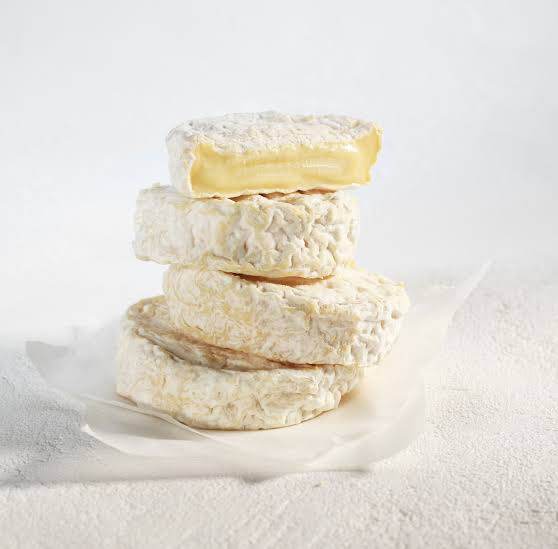
A small round disc of cow's milk, a white rind, a soft paste. Eighty grams, seven centimetres in diameter. Two details worth knowing: it was originally made with goat's milk, before transitioning through a goat-cow blend, then settling definitively on cow's milk. It also obtained its IGP designation in late 2013, covering 274 communes spread across Isère, Drôme and Savoie. Everything else is determined by the ripening.
A story of woodcutters and travelling merchants
Every fact sheet will give you the same story: around 1445, the future Louis XI, then governor of the Dauphiné, becomes lost during a hunt in the Vercors and comes face to face with a bear. Two woodcutters help him, then offer him bread and a Saint-Marcellin to recover. The story is appealing, but it is more legend than established fact. What holds solidly is that the INAO places the first written mentions of this cheese under the reign of Louis XI.
Its real take-off came in the 19th century, thanks to the coquetiers — travelling merchants who collected eggs, cheeses and vegetables from farm to farm to resell them in town — and the development of communication routes, notably the Paris-Lyon-Marseille axis.
The Lyonnais masterstroke: a cheese you eat with a spoon
In its Dauphiné birthplace, Saint-Marcellin was typically eaten rather dry — firm, slightly crumbly, serious. What changed everything was the so-called Lyonnais ripening: pushing the cheese much further, for four weeks or often more, until it becomes genuinely runny. So runny, in fact, that you no longer cut it — you eat it with a spoon, scraping and spreading. This is precisely why the earthenware cup has become a standard format.
In other words, the Saint-Marcellin that Lyon has made its own is not the original Dauphiné cheese. It is an urban reinterpretation of a peasant product. A city took a keeping cheese and turned it into one of immediate pleasure.
La Mère Richard and Monsieur Paul
This Lyonnais version has an address and a face. The house was founded in 1965 by Renée Richard at the Halles des Cordeliers, before moving in 1971 to the Halles de Lyon, now bearing Paul Bocuse's name. At a time when Lyon lacked a signature cheese specialty, and when the prevailing habit was to sell Saint-Marcellin barely ripened, she chose to make it runny and melting. It is this ripening work — not a chef's recipe — that created the product Lyon knows today.
Paul Bocuse's role was decisive in a different way. A regular at the Halles, he served her cheeses at Collonges — a relationship lasting more than fifty years. Above all, he inscribed his ripener's name on his menu, under the mention 'fromages de la Mère Richard.' To measure the weight of that gesture, recall that Paul Bocuse, born at Collonges-au-Mont-d'Or in 1926, was a Meilleur Ouvrier de France, held three Michelin stars at Collonges from 1965 onwards, and was named 'Chef of the Century' by Gault & Millau in 1989.
Which wine, according to the ripening
This is where people most often go wrong. We speak of Saint-Marcellin as a single cheese, when in fact there are three or four different cheeses within the same cup depending on when you open it. Here is how to proceed step by step.
The youngest, firm and discreet. The paste is still compact, the flavour lactic, slightly acidic, very gentle. It needs a light, dry, taut white: a Roussette de Savoie, an aligoté, a Jura chardonnay without oak. The wine's acidity mirrors the cheese's, and the delicacy of one respects the other.
Mid-ripened, supple. The centre starts to melt, hints of hazelnut and honey appear. You can move to red, provided it stays light. This is the moment for gamay: a Beaujolais-Villages or a Chiroubles, fruity, fresh, served cool. Its discreet tannins won't clash with the cheese's softness.
Well-ripened, creamy. Fat becomes dominant. Two options work equally well: a Beaujolais cru with a little more substance (Fleurie or Morgon), or bubbles — a Crémant de Savoie or du Jura. The acidity and effervescence refresh the palate between spoonfuls.
Very runny, almost liquid. The flavour is frank, sometimes with a slightly sharp edge. This is the only stage where a wine of character becomes relevant: a Jura Savagnin, or even a Vin Jaune, or a northern Rhône Syrah with a few years in bottle and softened tannins.
Whatever the ripening stage, two things never work: a young, highly tannic red, which will harden against the cheese, and a heavily oaked white, which will crush it. And one last piece of advice worth more than any pairing: take it out of the refrigerator an hour before serving. Cold anaesthetises its aromas, and a Saint-Marcellin served too chilled will reveal nothing of its honey and fruit.
To conclude
The journey of this cheese illustrates quite well what gastronomy does to products. A farmhouse cheese, carried to the city in the baskets of travelling merchants, pushed to a runny state by Lyonnais rippers, then consecrated by a chef who had the elegance to put his cheesemaker's name on his menu.
This is exactly the kind of story we love to tell, glass in hand, during our tastings in Lyon. A perfectly ripened Saint-Marcellin, a well-chilled Beaujolais cru, and everything becomes clear.